
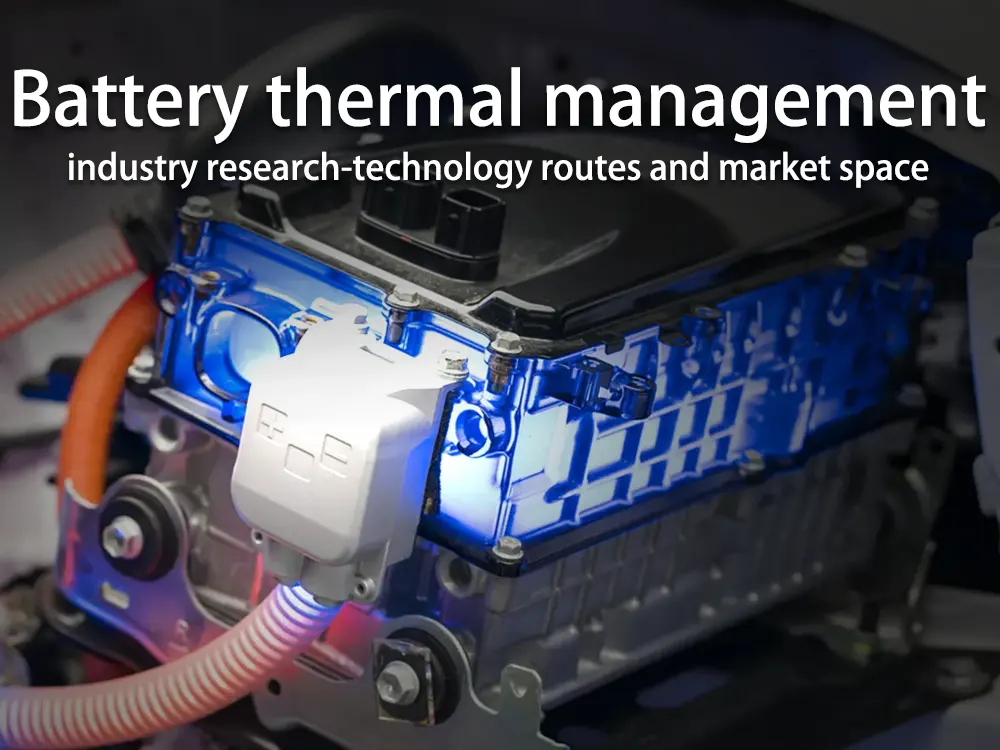


Overview of thermal management
The need for battery thermal management
In the process of charging and discharging lithium batteries, part of the chemical or electrical energy is converted into thermal energy, such as poor heat dissipation in the energy storage system, which may lead to thermal runaway, resulting in battery short circuit, bulging, open flame, and eventually fire, explosion and other safety accidents.
According to statistics, more than 60 global energy storage safety accidents have occurred in the past decade, and as of the end of April this year, eight energy storage safety accidents have occurred worldwide. Li-ion battery thermal runaway is one of the main causes of energy storage system safety accidents. This highlights that battery thermal management has become an important component essential to ensure the safe operation of energy storage plants.
The thermal performance of Li-ion battery is directly related to the discharge multiplier, and the thermal performance also determines the operating efficiency, safety and reliability of the battery itself. When the discharge rate of the battery increases, the capacity that can be discharged from the battery decreases, and the discharge platform decreases, making it unstable and causing the battery temperature to rise.
And in the large rate (i.e. 1.5C or more) discharge, the operating temperature of lithium batteries will exceed the ideal operating temperature. At present, large rate discharge has gradually become a trend, which will further increase the demand for battery thermal management.
What does thermal management mean specifically? Thermal management means the process of regulating and controlling the temperature or temperature difference according to the requirements of specific objects (such as battery systems, base stations, IDC, new energy vehicles) by using heating or cooling means. Take lithium battery as an example, 15-20℃ temperature environment for lithium-ion battery to play a higher efficiency. If the battery operating temperature exceeds 50 ℃, the battery life will decay rapidly, and may even cause safety accidents.
The design of energy storage system requires reasonable battery thermal management or temperature control design to ensure two thermal management indicators: one is to ensure that the battery surface temperature is within a specific range, and the other is to keep the temperature difference between the batteries small. Battery thermal management accounts for 3% of the system cost of the energy storage plant, the initial investment cost is relatively low compared to battery systems, PCS, etc.

The need for battery thermal management in energy storage:
Compared with the power battery system, the battery of energy storage system has more power and more quantity, which generates more heat, and the close arrangement of the battery leads to limited space for heat dissipation, which makes it difficult to disperse heat quickly and evenly, and it is easy to cause heat accumulation between battery packs and excessive operating temperature difference, which eventually damages the life and safety of the battery.
The importance of battery thermal management system is increasing as the energy storage system actively participates in peak and frequency regulation, and the heat production increases significantly under the development trend of high multiplier and high capacity.
Ideally, battery thermal management is designed to keep the temperature inside the energy storage system in the optimal temperature range for lithium battery operation and to ensure temperature uniformity inside the battery pack, thus reducing the risk of battery life degradation or thermal runaway.
Battery thermal management is in the midstream of the electrochemical energy storage industry chain
The electrochemical energy storage industry chain is divided into upstream equipment manufacturers, midstream integrators, and downstream applications.
The upstream equipment includes battery pack, PCS, BMS, EMS, thermal management and other equipment, most practitioners are extended from other similar fields; the core of the midstream chain is system integration + EPC; the downstream is mainly divided into four scenarios: power generation, grid, household/commercial, and communication. Most companies in the energy storage industry chain are involved in 1-2 of these segments, and a few companies are involved in all aspects from battery to system integration and even EPC.
Battery pack is the most important component of energy storage system, and lithium and sodium batteries have great potential. Different types of batteries differ in energy density, power density, cost, safety, etc.
According to calculations, from the perspective of the whole life cycle, the preliminary investment costs of lithium-ion batteries, lead-acid batteries and liquid-flow batteries are comparable, but taking into account the later maintenance, lithium-ion batteries show obvious cost advantages. At present, sodium-sulfur batteries have not yet formed a mature industry chain, but they are expected to become a lower-cost technology category.
The battery cost of energy storage system accounts for about 55%, PCS accounts for about 20%, BMS and EMS together account for about 11%, battery thermal management accounts for about 2%-4%. The value of battery thermal management is relatively low, and downstream manufacturers value the stability and safety of battery thermal management solutions, and the price sensitivity is relatively low, and it is easy to form a binding relationship with the solution provider, and the frequency of changing suppliers is lower.

Technology route and market space for battery thermal management
Air cooling system
Air-cooling uses air as a medium to transfer heat by using the thermal convection generated by the temperature difference between air to achieve heat dissipation. Air cooling heat dissipation is divided into natural air cooling and forced air cooling.
Natural cooling uses natural wind pressure, air temperature difference, air density difference, etc. to dissipate heat from the battery, but due to the low heat transfer coefficient of air, natural convection heat dissipation is difficult to meet the heat dissipation demand of the battery.
Forced air cooling requires additional installation of air conditioner and blower to make external air pass through the gap/bottom of the battery cell, and the air conditioner is responsible for regulating the overall ambient temperature to meet the battery working temperature demand.
Liquid cooling system
Liquid cooling has obvious advantages over air cooling, or the future direction of mainstream energy storage temperature control development. Because of the development of lithium batteries to higher energy density, and liquid cooling solution can accommodate higher energy density energy storage system.
A brand of liquid-cooled energy storage system, for example, equipped with 1500V energy storage battery, installed capacity of 3.44MWh, container size of only 20 inches, compared to the traditional 40-inch air-cooled system not only energy density increased by 100%, energy consumption is also reduced by 30% +, while supporting energy storage system assembly, can save more than 40% of the floor space.
Liquid cooling system solution is closer to the heat source, the overall temperature is uniform, which is conducive to prolonging the battery life and more suitable for outdoor environment than air cooling. The liquid cooling system also has the ability to control temperature more precisely, and the existing products can precisely control the temperature difference of all the battery cells in the cabinet within 2.5℃ to improve the efficiency of battery charging and discharging.
Liquid cooling uses liquid as the cooling medium to take away the heat generated by the battery through convective heat transfer. Liquid cooling medium has high heat transfer coefficient, large specific heat capacity and fast cooling speed, which can effectively reduce the maximum temperature of the battery and improve the uniformity of temperature distribution, while the structure of liquid cooling system is more compact.
There are two contact modes of liquid and battery: one is direct contact, the battery unit or module immersed in the liquid, so that the liquid directly cools the battery, this program requires higher insulation.
The other is to set up a cooling channel or cold plate between the battery, so that the liquid indirectly cools the battery, the majority of energy storage systems use this program. The research of liquid cooling technology mainly focuses on the selection of liquid coolant, optimization of flow channels, optimization of flow rate and thermoelectric coupling model.

The competitive landscape of battery thermal management
Temperature control and automotive thermal management companies join the industry
The players in the energy storage system battery thermal management industry are divided into four categories based on the source of technology lines:
first, companies with both air-cooled and liquid-cooled technologies in the field of temperature control;
second, companies with mainly air-cooled technologies;
third, companies with mainly liquid-cooled technologies;
and fourth, companies related to automotive thermal management. Since energy storage thermal management belongs to a single project system, it has the characteristics of customization and personalization, which requires companies to have outstanding advantages in operational efficiency and comprehensive cost.
Differentiated technical requirements of energy storage liquid cooling and power battery thermal management
Energy storage battery and power battery system have different application scenarios, performance and life time. There is no significant difference between the two in terms of technical principles, but due to the different application scenarios and battery capacity, the requirements for the performance and service life of the two are different.
Power batteries pursue higher energy density and charging speed, while energy storage batteries require less energy density, but need higher cycle times; energy storage systems have large capacity and higher requirements for battery consistency, system cost and service life, which test battery management system and energy management system performance more.

The battery thermal management of energy storage system works non-stop and has high safety requirements. Power battery pursues higher energy density and charging speed, while the whole vehicle needs to control the mass and volume, usually using liquid cooling system.
Energy storage batteries do not require high energy density, charging speed, mass and volume, but usually need to work uninterruptedly and have a longer life span, requiring thermal management systems to have the ability to work stably for a long time and a life span of more than ten years.
As energy storage batteries have more cycles and different consistency between battery packs, the risk of thermal runaway is greater. In addition, energy storage batteries for security requirements are higher, buildings, supermarkets and other sensitive areas with heavy traffic and the loss and impact of safety accidents in the field of power preparation is unacceptable, so the need for a more stable and safer battery thermal management system.





 English
 French
 German